
How far away are the stars? Climbing the Cosmic distance ladder.
Dr Matthew Bothwell
This month’s meeting we have our Hon president Dr Matthew Bothwell coming to give us his second talk of the year (He kindly agreed to come back as he was unable to talk to us last year). Matt as most of you know is the head of outreach for the Institute of Astronomy at the University of Cambridge and always delivers exceedingly good talks to his society. May’s talk was on "Exoplanets and biosignatures - including the latest on the K2-18b kerfuffle", this month it’s "How far away are the stars? Climbing the cosmic distance ladder"
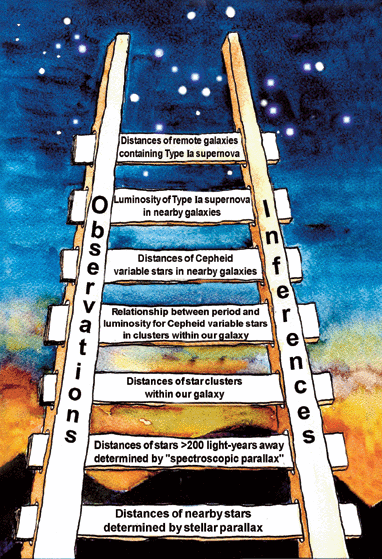
Matt breaks down the core astronomical concept of the Cosmic Distance Ladder, explaining the sequential methods scientists use to measure distances across the universe—from nearby stars to galaxies billions of light-years away.
What is the "Cosmic Distance Ladder"?
Because astronomers cannot fly a tape measure out into space, they rely on an overlapping chain of techniques. Each "rung" of the ladder builds on the mathematical calibration of the previous one:
Rung 1: Trigonometric Parallax (Nearby Stars)
As the Earth orbits the Sun, nearby stars appear to shift slightly against the background of more distant stars. By measuring this angle change (parallax), astronomers use simple geometry to calculate precise distances.Rung 2: Standard Candles (Milky Way & Nearby Galaxies)
For objects too far for parallax, scientists look for objects with a known intrinsic brightness. Cepheid variable stars are the classic example; their pulsation rate directly reveals how bright they actually are. By comparing how bright a Cepheid looks to how bright it actually is, astronomers can calculate its distance.Rung 3: Type Ia Supernovae (Distant Galaxies)
When these specific exploding stars detonate, they always peak at nearly the exact same intrinsic brightness. Because they are incredibly bright, they can be seen across vast expanses of the universe, acting as ultra-powerful standard candles.Rung 4: Hubble's Law & Redshift (The Deep Universe)
At the furthest scales, astronomers measure how much a galaxy's light has been stretched (redshifted) by the expansion of the universe. Using Hubble’s Law (v = H₀d) the velocity of the galaxy reveals its distance.
And after the break - TBA
Please remember that the meeting slot after the tea break is vacant awaiting volunteers . If you would like to fill this slot with a talk, an image expo, a fun quiz or anything astronomy related please get in touch. There is no regular speaker for this slot and without volunteers there will not be a second session.
Please feel free to e-mail the Chair (n_m_gray@btinternet.com) if you would like to speak on any astronomy related talk after the coffee break.
The meeting will be held at Standalone Farm and will also be available over Zoom to Members. Please purchase your tickets in advance via MemberMojo to receive the Zoom link.
£2 for Members and £3 for Guests.
Guests can attend two physical meetings in the year before having to pay membership.